
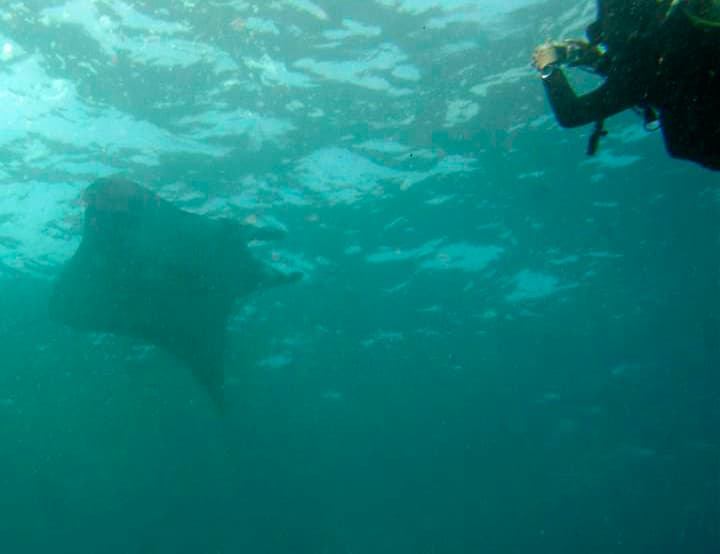
Manta Point
Bali & Nusa Penida, Indonesia
Mantas visit the cleaning stations here all year, sometimes in courtship 'manta trains' of up to 30.
- Advanced
- Rock formations
- Manta rays
Dark: peak season. Light: regularly seen.
| Destination | Jan | Feb | Mar | Apr | May | Jun | Jul | Aug | Sep | Oct | Nov | Dec |
|---|---|---|---|---|---|---|---|---|---|---|---|---|
| CozumelPeak Nov–Mar | ||||||||||||
| Cancún & Isla MujeresPeak Nov–Feb | ||||||||||||
| Canary Islands (Lanzarote & Fuerteventura)May–Nov | ||||||||||||
| MaldivesDec–May | ||||||||||||
| MauiSep–Feb | ||||||||||||
| Cayman IslandsDec–Apr | ||||||||||||
| Poor Knights IslandsMay–Sep | ||||||||||||
| Medes Islands (Costa Brava)Jun–Sep | ||||||||||||
| Fakarava & RangiroaJan–Mar |
Sources confirm them, but don't say in which months.
Spotted eagle rays have a dramatic spotted pattern on the back, a duckbill-shaped snout and a long, whip-like tail that can reach 2.5 to 3 times the width of the disc. The tail carries venomous spines used in defence. They feed on clams, oysters, shrimp, octopus, squid, sea urchins and bony fish.1
Sources differ on maximum size: the Florida Museum gives a disc width of 3 m and a weight of 230 kg, while FishBase and the Bimini Biological Field Station give 230 cm disc width for the Atlantic species. FishBase says the Indo-West Pacific species can exceed 3 m.1,2,3,4
The whitespotted eagle ray lives in tropical to warm temperate Atlantic waters, over the continental shelf in lagoons, estuaries, coral reefs and open water, commonly to at least 60 m. The ocellated eagle ray ranges from East Africa and the Red Sea to Hawaii and French Polynesia, in coastal waters from 1 to 100 m, usually 20 to 25 m.2,3,4
In open water they often form large schools close to the surface, and they can leap clear of the water when pursued.1
On the IUCN Red List, the whitespotted eagle ray (Aetobatus narinari) was assessed as Endangered in July 2020, and the ocellated eagle ray (Aetobatus ocellatus) as Endangered in July 2023. The Bimini Biological Field Station notes that the species is also at risk from the aquarium trade.2,3,4
Spotted eagle rays are generally shy and wary of divers, and hard to approach. The Florida Museum notes that they are considered potentially dangerous to humans because their venomous tail spines can inflict serious wounds. No eagle-ray-specific code was found; Lady Elliot Island's (Great Barrier Reef) general marine encounter guidelines give these rules.1,5
Sources checked on 28 October 2026. Written from these pages and checked by an independent second reader.
Bali & Nusa Penida, Indonesia
Mantas visit the cleaning stations here all year, sometimes in courtship 'manta trains' of up to 30.

SS Yongala (Townsville), Australia
Sunk by a cyclone in March 1911, the wreck lies on a 30 m seabed with its upper parts at 16 m; penetration diving is prohibited by law.

Malta, Gozo & Comino, Malta
An 80 m tunnel leads from Dwejra's enclosed lagoon to the open sea, deepening from 3 m to 26 m at the seaward end.

Malapascua, Philippines
A plateau where thresher sharks rise at dawn to visit cleaning stations.

Komodo, Indonesia
Shallow manta cleaning-station drift where reef mantas show up year-round, peaking December–April with 4–12 on a good dive.
Bonaire
East-coast reef for experienced divers with a guide, where turtles, eagle rays and moray eels thrive and large schools including tarpon roam.

Bonaire
Part of Bonaire's southern double reef system, with a good chance of seeing turtles and eagle rays.

Palau
Hook in above the wall and watch resident grey and whitetip reef sharks, tuna and barracuda work the current.

Belize
Garden eels on a 6 m sand shelf give way to a wall dropping past 30 m into the abyss, with reef sharks patrolling its edge in gentle currents.

Galápagos, Ecuador

Belize
A shallow channel about 9 m deep in a marine reserve, where large groupers, nurse sharks, stingrays and green moray eels can be seen.

Palau
A channel blasted through the reef where manta rays visit cleaning stations, with peak sightings from December to March.


