
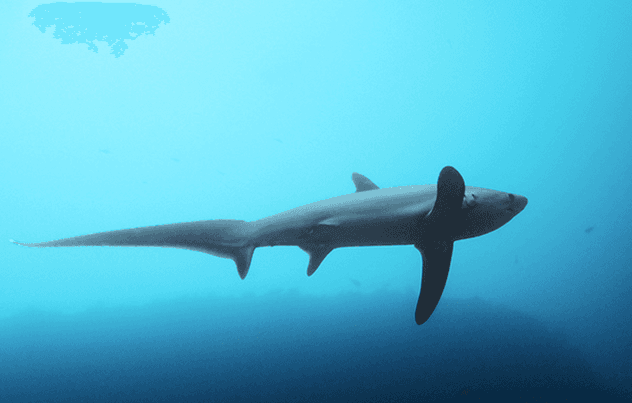
Monad Shoal
Malapascua, Philippines
A plateau where thresher sharks rise at dawn to visit cleaning stations.
- Advanced
- Pinnacle
- Bull sharks
Dark: peak season. Light: regularly seen.
| Destination | Jan | Feb | Mar | Apr | May | Jun | Jul | Aug | Sep | Oct | Nov | Dec |
|---|---|---|---|---|---|---|---|---|---|---|---|---|
| MalapascuaPeak All year | ||||||||||||
| MaldivesAll year | ||||||||||||
| Sharm El Sheikh & Ras MohammedSep–Nov |
Sources confirm them, but don't say in which months.
The pelagic thresher (Alopias pelagicus) averages about 300 cm (10 feet) and can reach 365 cm total length. Its long upper tail lobe makes it easy to recognise.1,4
Researchers, including members of the Thresher Shark Research and Conservation Project in the Philippines, filmed threshers using that tail to hunt: the sharks lift their rear body and slap the tail into schools of small fish, creating shockwaves that stun or kill the prey.5
The pelagic thresher lives in warm and temperate offshore waters of the Pacific and Indian oceans. It is found from the surface to at least 150 metres, and some sources give depths to 300 metres.1,4
At Monad Shoal in the Philippines, a seamount whose top lies at 15 to 25 metres, reef fish pick parasites and loose skin off the sharks at cleaning stations around 30 to 35 metres deep. A study there recorded threshers being cleaned at all times of day, but less often from morning towards evening; a WWF, Manta Trust and Project AWARE factsheet says dives there mostly take place between dawn and 9 am, when sightings are most regular.2,3
The pelagic thresher is listed as Endangered globally on the IUCN Red List, with a decreasing population, according to a document submitted to the 15th Conference of the Parties of the Convention on Migratory Species. The assessment year is not stated there, only that the global thresher assessments are more than seven years old. A 2011 study still described it as Vulnerable, an older listing.3,4
Threshers at cleaning stations are vulnerable to disturbance, and researchers at Monad Shoal suggested they may interact less with cleaner fish when many divers are present. A thresher code of conduct developed with dive operators and local authorities in Fuvahmulah, Maldives, sets out these rules for dives there.3,6
Sources checked on 28 October 2026. Written from these pages and checked by an independent second reader.
Malapascua, Philippines
A plateau where thresher sharks rise at dawn to visit cleaning stations.

Moalboal, Philippines
A sardine ball that spreads from 2 to about 15 m off Panagsama Beach, hunted by mackerels and tuna, with a thresher shark if you are lucky.

Malapascua, Philippines
Sandbar island with drop-offs where turtles patrol the walls and a thresher shark occasionally appears.

Marsa Alam & the Brothers, Egypt
Sheer coral walls plus two wrecks, the Numidia and Aida, with a chance of thresher sharks on dawn dives in autumn and winter.

Marsa Alam & the Brothers, Egypt
Lighthouse reef 80 km off Marsa Alam, only reached by liveaboard, where schooling hammerheads gather, especially in summer.
Pinnacle
down to 40 m
Malapascua, Philippines
Since 2022 the main thresher shark cleaning station, with a plateau at 12 m and cleaning from 12 to 22 m.
Drift
down to 40 m
Aliwal Shoal & Protea Banks, South Africa
A marine protected area since 2019 where dives bring close encounters with tiger, bull and hammerhead sharks and giant guitarsharks.
Drift
down to 40 m
Bali & Nusa Penida, Indonesia
A reef on Penida's quieter east coast with bommies and sea fans, where turtles and thresher sharks are reported.
Wall
down to 40 m
Bohol & Panglao, Philippines
A black-coral and sea-fan wall dropping past 40 m where grey reef sharks, eagle rays and schools of jacks patrol.
Drift
down to 40 m
Bali & Nusa Penida, Indonesia
A drift along a sloping coral reef on Penida's north-east with tuna, barracuda, trevally and turtles, and Mola Mola in season.
Wall
down to 40 m
Sipadan & Semporna, Malaysia
One of Sipadan's more likely sites for rare hammerhead and thresher shark sightings, usually deeper than 40 m.
Drift
down to 40 m
Puerto Galera, Philippines
A drift down a wall into three canyons, with schools of drummers, snappers, sweetlips, batfish, emperors and trevally.


