
The Moken: sea nomads of the Andaman Sea

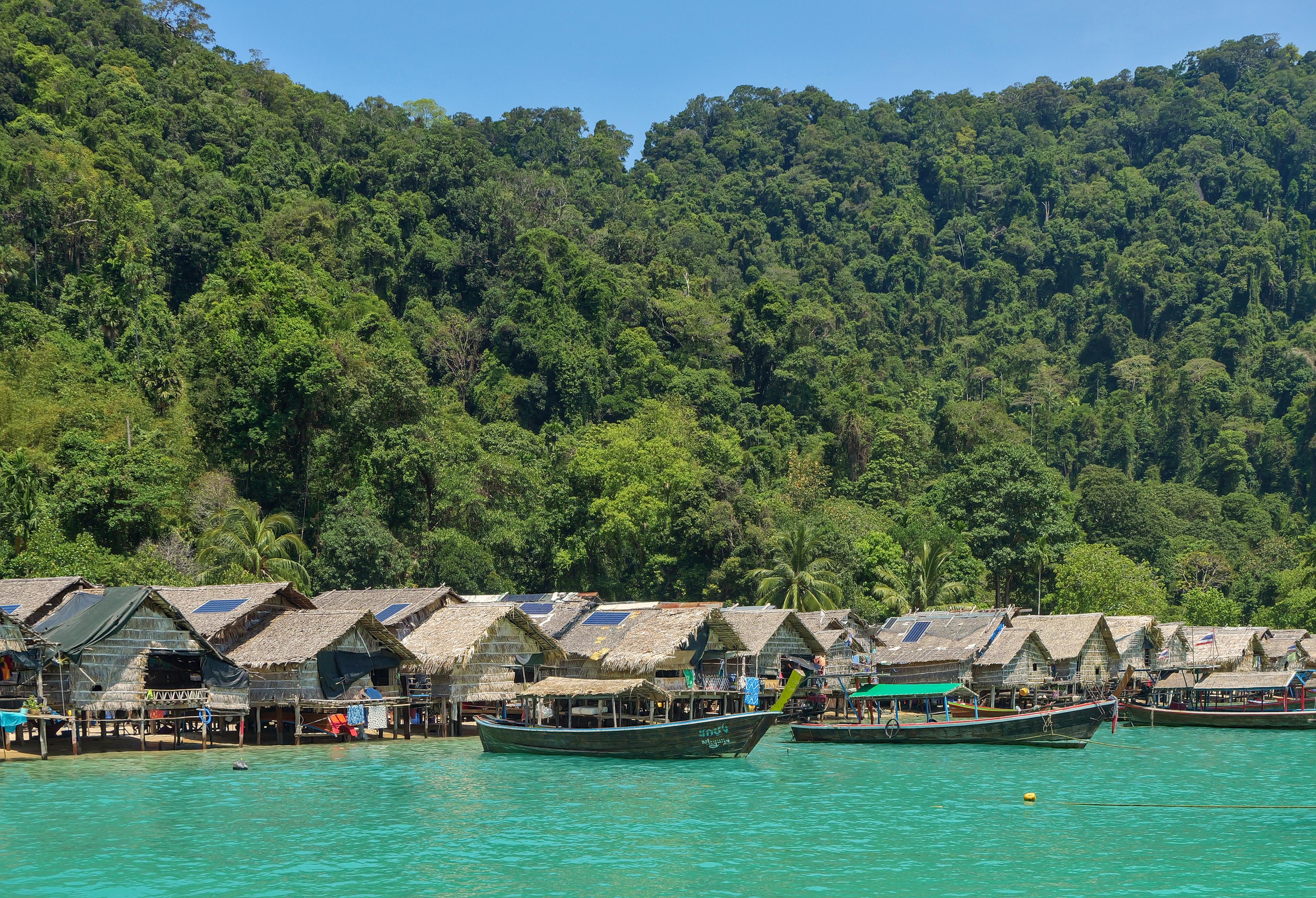

On 26 December 2004 the Indian Ocean tsunami wiped out a Moken village on South Surin Island, in Thailand's Andaman Sea, but the community had evacuated to higher ground and survived. The story of how they knew to go is real, though the accounts of it differ.1,2,3
A people of boats and islands
The Moken live in the archipelago off Burma (Myanmar) and along Thailand's west coast. They are one of three groups of sea nomads in Thailand, with the Moklen and Urak Lawoi, and their languages belong to the Austronesian family. Narumon Arunotai, an associate professor at Chulalongkorn University, puts the Moken population in Thailand at around 1,000, and cites an estimate of about 2,000 in the Mergui Archipelago.1,4,5
Their traditional home was the kabang, a seaworthy boat made from a dug-out log with gunwales of light zalacca stems. Several generations could live aboard, and the boats were once much bigger. Arunotai describes families living on their boats through the dry season, from mid October to mid May, then camping in sheltered bays or settling in small communities during the wet season; Associated Press reporting likewise says the Moken stayed on land only in the monsoon, which began around May.1,6
Food came from fishing and foraging, including freediving for fish that could be traded for rice. Even children dived for shells, clams and sea cucumbers without visual aids.2,4,6
The morning the sea pulled back
On Surin, a Moken man named Ngoei told The Guardian that he noticed the tide receding and boats stuck in the sand, went back to the village to talk it over with the elders, and that his family then decided to evacuate. Within minutes the wave had hit, its booming chasing them uphill. The Guardian reports that the Moken all survived, and the navy later moved everyone to a Buddhist temple in Kuraburi on the mainland.2
CBS's 60 Minutes told a parallel account of a spear-fisherman, Saleh Kalathalay, who raised the alarm on a Thai island and was at first dismissed: 'The young people called me a liar.' In the end, CBS reported, Moken and tourists alike climbed to higher ground. Moken already at sea in Burmese waters headed for deeper water and were spared.7
What the laboon stories actually say
Moken oral tradition speaks of the laboon. Arunotai translates it simply as a giant wave that comes once in a while to cleanse the earth, and notes that young sea nomads are taught to run to higher ground when the sea suddenly recedes. CBS described it as the 'wave that eats people', brought on by angry ancestral spirits, while a Bangkok Post feature calls it a furious god of the waves said to strike every two generations. As The Guardian put it, there were as many laboon stories as there were people to tell them.1,2,3,7
Arunotai's reading is practical rather than mystical: she writes that the legend cleverly encoded the danger of a tsunami. Some caution is also needed on the toll. Reports agree that the Surin villagers survived, but Arunotai notes that a few sea nomads in Thailand were among the dead. Thailand's Interior Ministry reported 4,244 people killed and 1,659 missing nationwide. The fame the sea nomads gained afterwards, Arunotai adds, was short-lived.1,2
Children who see clearly underwater
Humans are poorly adapted to seeing underwater. In 2003 a team led by Anna Gislén published a study in Current Biology that compared the underwater vision of 6 Moken children with 28 European children. The Moken children's underwater acuity measured 6.06 cycles per degree, more than twice the European children's 2.95.4,8,9
The difference lay in how they used their eyes. Underwater, the Moken children constricted their pupils to 1.96 mm, against 2.50 mm in the European children, and focused at the known limit of human performance. The authors found this response routine in Moken children and completely absent in the European group.4
Gislén suspected the ability was learned. A follow-up in Vision Research in 2006 trained four European girls, aged 9 to 13, 11 times over 33 days in an indoor pool in Lund. Tested eight months after training, in an outdoor pool in bright sunlight, they reached the same underwater acuity as the Moken children, with no significant difference between the groups.8,10,11
Life on Surin today
The Surin Islands had become a national park by 1981, after which the Moken could no longer cut the large trees needed for boats; the 2004 tsunami destroyed many of the traditional boats. According to Arunotai, the shift to permanent dwelling on land began more than 40 years ago; AP describes it as a gradual shift driven by stricter border controls as well as the lack of wood. Thailand has no policy of forced settlement, Arunotai writes, but there is soft pressure to settle down. After the tsunami, park authorities merged two villages into one bay, Ao Bon Yai.1,2,5,6
Papers remain a central issue. Arunotai reported that more than half the Moken in Thailand were stateless as of 2017, and The Guardian described a Moken couple who received identity cards that restricted their movement. In 2024 a bill to guarantee ethnic groups' rights to health care, education and land was tabled in Parliament. Fishing is limited to a subsistence quota, and in 2024 the Surin village had only one kabang left.1,2,6
Why it matters for divers
Diving and snorkelling are the main activities in the Surin Islands, which open to visitors from mid October to mid May, and the Moken village is one of the few areas visitors may enter. Most young Moken make money only in the peak tourist season, but in 2014 The Guardian described daily boatloads of visitors photographing mothers and elders. In 2019 a fire destroyed about 65 houses in the village, and in 2025 the park rejected online claims of exploitation, saying it employs only adult Moken.2,6,12,13,14
Sources
- 1. epub.oeaw.ac.at
- 2. inkl.com
- 3. bangkokpost.com
- 4. sciencedirect.com
- 5. khaosodenglish.com
- 6. abcnews.go.com
- 7. cbsnews.com
- 8. sciencenews.org
- 9. lunduniversity.lu.se
- 10. local.psy.miami.edu
- 11. lunduniversity.lu.se
- 12. thainationalparks.com
- 13. bangkokpost.com
- 14. nationthailand.com
Sources checked on 19 November 2026. Written from these pages and checked by an independent second reader.
Where to dive next month
One email a month, around the 25th: the destinations in season the following month, with their sources, an article to read and an instructor's tip. Free, no ads.