
Harrison Okene and the air pocket of the Jascon-4


In May 2013 a Nigerian tugboat capsized and sank with 12 people on board. Divers sent to recover bodies found one man still alive inside the upturned hull, about 60 hours after the sinking.1,2
A tug overturns before dawn
On 26 May 2013 the tug Jascon-4 capsized in heavy Atlantic swells while stabilising an oil tanker that was loading at a Chevron platform off Nigeria. Reuters put the position at around 30 km off the coast, near Escravos according to the diving industry press; another report gave about 20 km. The wreck came to rest upside down, and the company said it lay 30 metres down.1,3,4
The ship's cook, 29-year-old Harrison Okene, told Reuters he was in the toilet at 4:50 a.m. when he realised the tug was turning over. Of the 12 people aboard, he was the only survivor. Divers later recovered ten bodies, and one crew member was never found.1,2,5
Sixty hours in the dark
Okene ended up in a pocket of air trapped in a small compartment, about 1.2 metres high by his own estimate, wearing only his underpants. He told Reuters he was very cold and that it was black. To keep out of the water he made a platform; accounts differ on the details, mentioning mattresses or a raft he made from ceiling panels.1,4,6,7,8
In a later Guardian article he described finding a tin of sardines and a can of cola in bags. He told Reuters that, after hearing hammering, he pulled the water filter and hammered the side of the vessel, hoping someone would hear him.1,4,8
How long he was trapped is reported in slightly different ways. Reuters and ABC News say more than 60 hours; the South China Morning Post says almost 60; the diving contractor's account, published by Offshore Energy, says 62 hours.1,3,4,9
The divers who were looking for bodies
The recovery team came from the Dutch company DCN Diving. According to the AP, they were searching only for bodies and had already recovered four when they found Okene. Their dive support vessel had been 17 hours' sailing away, and its divers were living in saturation at a pressure of 70 metres.2,3,9
Okene told the AP that the first diver who passed was too fast, and that he could not follow him in the pitch darkness. When a diver did reach him, he was warmed with hot water and given an oxygen mask. The diver, Nicolaas van Heerden, later told the BBC that the moment someone grabbed him was the most frightening of his career. Video of the rescue went viral when it was put online in December 2013.2,10
Why he could not simply be brought up
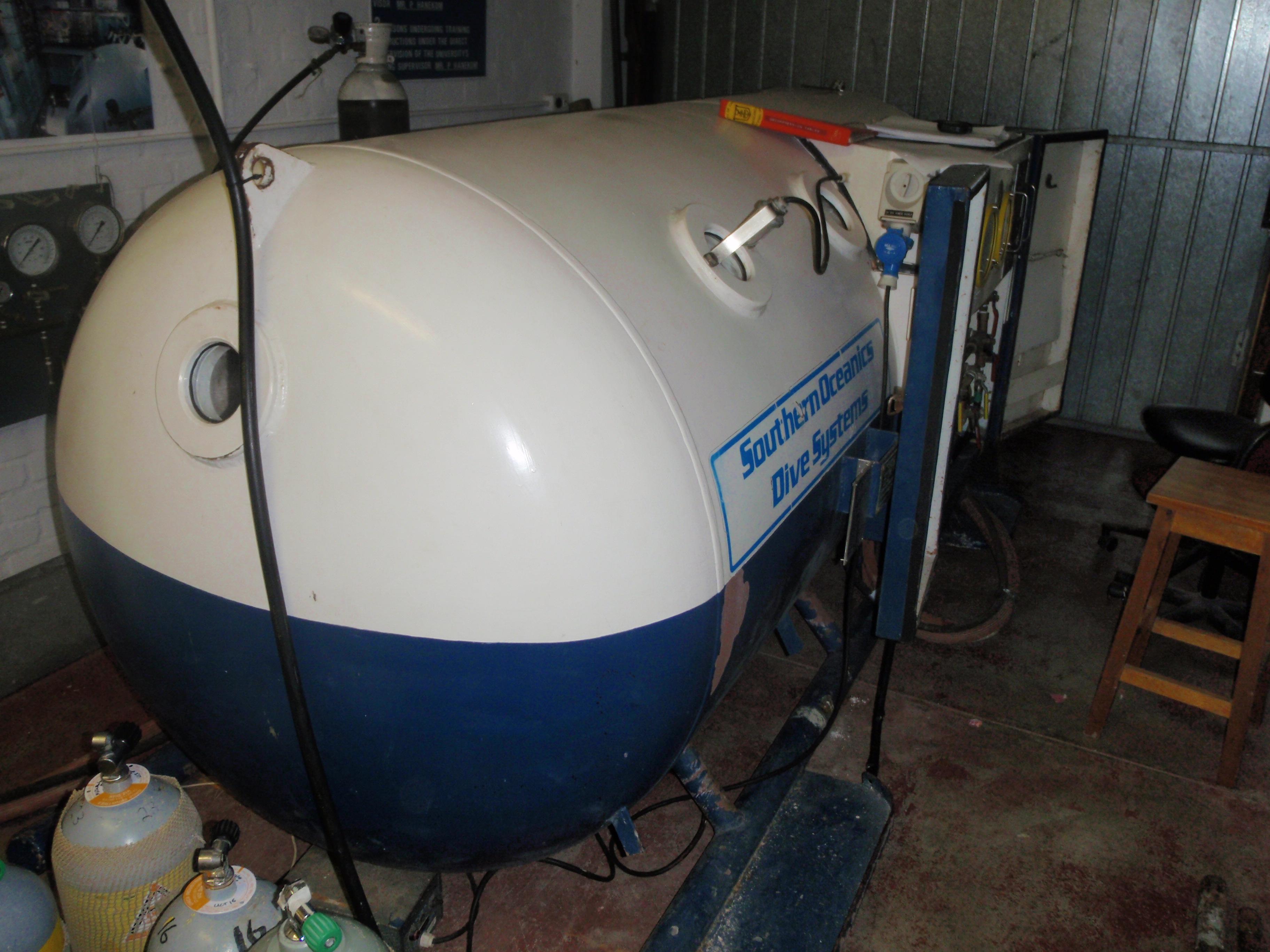
Pressure increases by one atmosphere for every 10 metres of depth, so at about 30 metres Okene had been breathing air at roughly four times surface pressure. DAN explains that the body's tissues absorb nitrogen from the breathing gas under pressure, and that if pressure is reduced too quickly the gas can come out of solution as bubbles, causing decompression sickness. DAN's Alert Diver magazine adds that a diver who stays at depth for more than 12 to 18 hours becomes fully equilibrated with nitrogen at that depth.6,11,12,13
Petar Denoble of DAN told National Geographic that Okene could not return to the surface immediately, and that if he did he would die. Van Heerden said the team could not just take him up; he had to be decompressed. National Geographic reports that the group entered a diving bell, which Denoble said would have been kept at bottom pressure; Okene then spent time in a decompression chamber.1,10,14
Accounts of the chamber stay vary. Reuters and the AP reported about 60 hours, and the Guardian and BBC Mundo three more days; an early report in the Washington Times said several hours.1,2,7,8,10
How an air pocket can keep someone alive
Physicist Maxim Umansky of Lawrence Livermore National Laboratory estimated, as reported by Live Science, that the trapped air was compressed by a factor of about four. Eric Hexdall of Duke University's hyperbaric centre told National Geographic that in such a space carbon dioxide reaches toxic levels before the oxygen runs out.6,14
Experts did not fully agree on how close Okene came. Hexdall estimated that he would have begun to feel the first symptoms of carbon dioxide toxicity after about 56 hours, while Umansky concluded the gas stayed at safe levels, partly because splashing increased the water surface able to absorb it. Live Science notes that carbon dioxide is lethal at about 5 percent, and DAN Europe's magazine describes how excess carbon dioxide causes confusion and can end in loss of consciousness.6,14,15
After the rescue, and why it matters for divers
In December 2013 the AP reported that Okene still had nightmares, had vowed never to return to the sea and had taken a job as a cook on land. Later reporting tells a different chapter: the Guardian reported that he had taken a three-month diving course and was working as a diver on oil and gas facilities, with a maximum depth of 50 metres, and BBC Mundo also reported that he became a professional diver.2,8,10
- DAN explains that gas breathed at depth is absorbed by the body, and that reducing pressure too fast can cause decompression sickness.12
- Eric Hexdall of Duke's hyperbaric centre told National Geographic that in a closed air space, carbon dioxide can build to a toxic level before the oxygen runs out.14
Sources
- 1. maritime-executive.com
- 2. ksl.com
- 3. offshore-energy.biz
- 4. scmp.com
- 5. theworld.org
- 6. livescience.com
- 7. m.washingtontimes.com
- 8. inkl.com
- 9. abcnews.com
- 10. teletica.com
- 11. slate.com
- 12. dan.org
- 13. dan.org
- 14. nationalgeographic.com
- 15. alertdiver.eu
Sources checked on 19 November 2026. Written from these pages and checked by an independent second reader.
Where to dive next month
One email a month, around the 25th: the destinations in season the following month, with their sources, an article to read and an instructor's tip. Free, no ads.