
John Scott Haldane, goats and the invention of decompression stops

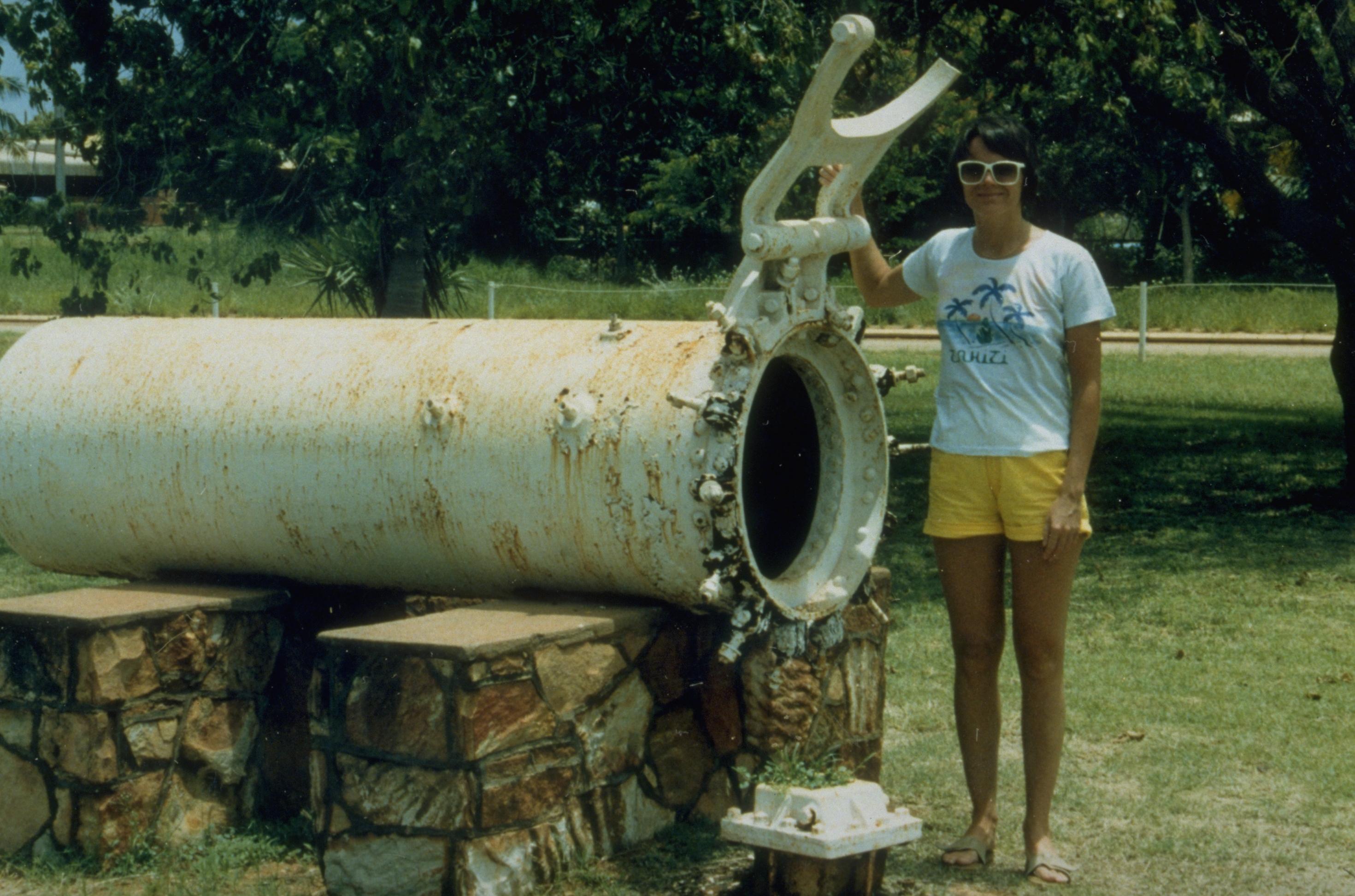

In 1908 John Scott Haldane and two colleagues published a paper, built on experiments with goats in a steel compression chamber, that recommended staged decompression: a safer way to bring divers up from deep water. Before them, compressed-air workers on bridge projects were seriously injured and killed by decompression sickness.1,2,3,4,5
The bends before Haldane
According to Acott's chronology, the St Louis (Eads) bridge project, which he dates to 1871, employed 352 compressed-air workers; 30 of them were seriously injured and 12 died.5
Acott's chronology, under 1873, records that the Brooklyn Bridge project employed 600 workers. Its physician in charge, the ear, nose and throat surgeon Andrew Smith, was the first to use the term "caisson disease" and, according to Acott, described 110 cases serious enough for his attention (119 in total), 14 of whom died.5
Acott records that sufferers walked with a stoop resembling the "Grecian bend", a posture affected by fashionable women, and that during the Brooklyn project the colloquial term "the bends" was used.5
Paul Bert finds the bubbles
Paul Bert, who published "La Pression Barometrique" in 1878, showed that nitrogen bubbles caused decompression sickness and also recognised that "silent bubbles" form after decompression.5
Haldane and his co-authors built directly on this. Their 1908 paper credits Bert with showing experimentally that nitrogen dissolved in the blood and tissues under pressure comes out as bubbles if decompression is too rapid, blocking circulation or causing other injury. Knowing the cause, however, was not the same as knowing how to ascend safely.3
The Admiralty sets a problem
John Scott Haldane, born in Edinburgh in 1860, was a physiologist best known for his work on breathing. According to Acott, the British Admiralty appointed him in 1905 to develop safe decompression procedures, at a time when the Royal Navy limited air diving to 100 ft (30 m).5,6
The 1908 paper explains that the need for firm rules on safe decompression in the shortest possible time arose from the work of the Admiralty Committee on Deep Diving, of which one of the authors was a member. The committee's report on the conditions of deep-water diving was published by HMSO, and the National Maritime Museum's library catalogue dates it to 1907.3,7
Haldane worked with the pathologist Arthur Edwin Boycott and Lieutenant Guybon C. C. Damant of the Royal Navy. All three are listed as authors of the paper.1,2
Goats in the pressure chamber
The team chose goats because they were the largest animals that could be conveniently used, though they weighed only about a quarter to a third as much as an adult man. The paper reports 85 animals used in the experiments, which were run in a steel compression chamber.2,3
The experiments showed that the body takes up nitrogen at different rates in different parts. The paper estimated that saturation is roughly complete in about five hours in a man and about three hours in a goat, and it modelled body parts that half-saturate in 5, 10, 20, 40 and 75 minutes. A tissue "half-time" is the time for nitrogen to reach half its saturation value.2,3
From these results came the rule that defined the method. It was safe to reduce the absolute pressure quickly to one-half, for example from four atmospheres to two, but not safe if the pressure of nitrogen inside the body became much more than twice that of the nitrogen in the air. After that first rapid halving, the ascent had to become slower and slower.3
This overturned the earlier approach. Hill and Greenwood had recommended in 1906 a uniform decompression of 20 minutes per atmosphere. Haldane's team concluded that uniform decompression was an unsuitable way to bring a man out of compressed air: needlessly slow at the start and usually dangerously quick near the end. Their alternative was staged decompression, with the diver pausing at set stops on the way up.3,5
Damant's dive and the first tables
The method was then tested on people. Damant volunteered to be the first human subject after the animal work, and the paper reports experimental dives up to 210 feet made by Damant and a Mr Catto. Its appendix records Damant's dive in Loch Striven as just over 35 fathoms, 210 feet, which is about 64 m.2,3
The paper ended with tables giving the mode and duration of decompression, including stops at which the diver was told to keep moving his arms and legs. Accounts of what followed vary in their figures. Acott writes that the Royal Navy accepted the tables and used them for dives to 34 fathoms (204 ft, 61.2 m), while the Klose account in EBSCO gives Damant's maximum as 35 fathoms (210 ft) and says the navy adopted the tables immediately.2,3,5
Sources also differ on the date. Britannica credits Haldane with developing stage decompression in 1907, while the paper itself appeared in the Journal of Hygiene in 1908.1,3,6
What remains for divers today
Haldane's model spread quickly. The first US Navy diving tables, published in 1915, were a version of the original Haldane tables modified by French and Stillson. Later US Navy repetitive diving tables by Des Granges used tissue half-times of 40, 80, 120 and 240 minutes.5
In Zurich, the decompression work behind A. A. Bühlmann's tables used the perfusion-limited multi-tissue model associated with Haldane, later extended to 16 half-times. Bühlmann supported adapting the Zurich tables for dive computers, and in 1999 the SPUMS Journal noted that his algorithm was found in many of them.5,8
Writing for DAN Europe in 2011, Saul Goldman stated that the algorithms in all dive computers then on the market were still based on Haldane's model, in which each compartment stands for a tissue that may cause decompression illness.9
The staged ascent also survives in the safety stop. Writing in DAN's Alert Diver in 2016, Neal Pollock described its popularisation as probably the most significant change in decompression safety, and the Merck Manual (Professional edition) lists a 3- to 5-minute safety stop at 3 to 4 m (10 to 15 ft) among current recommendations.4,10
Sources
- 1. cambridge.org
- 2. ebsco.com
- 3. cambridge.org
- 4. dan.org
- 5. dhmjournal.com
- 6. britannica.com
- 7. rmg.co.uk
- 8. dhmjournal.com
- 9. alertdiver.eu
- 10. merckmanuals.com
Sources checked on 19 November 2026. Written from these pages and checked by an independent second reader.
Where to dive next month
One email a month, around the 25th: the destinations in season the following month, with their sources, an article to read and an instructor's tip. Free, no ads.