
The sponge divers who found the Antikythera mechanism

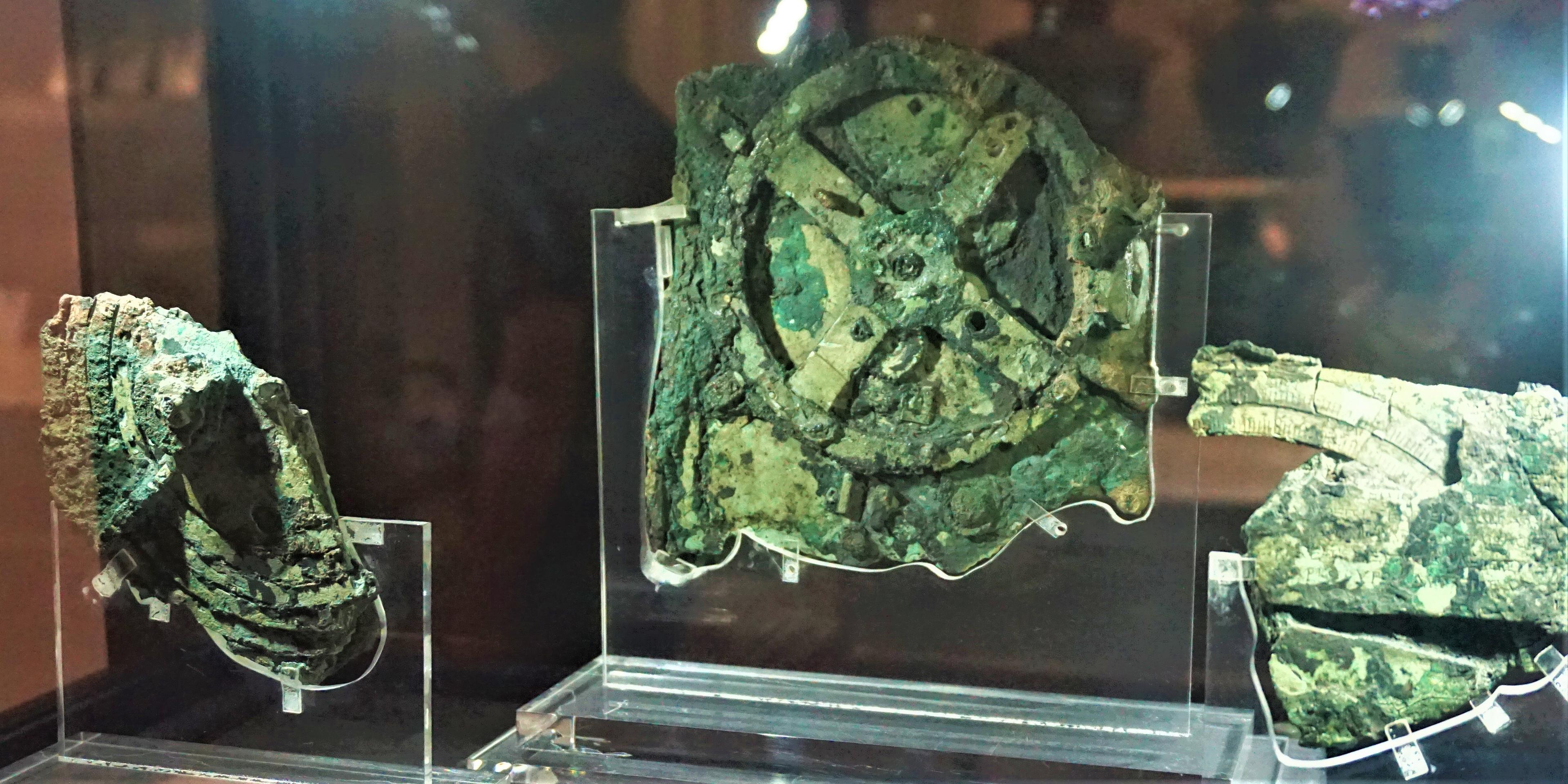

In 1900 a crew of Greek sponge divers, pushed off course by bad weather, found an ancient shipwreck off the small island of Antikythera. The salvage that followed cost one diver his life and left two paralysed, and its treasures were taken to the National Archaeological Museum in Athens. Among the corroded lumps of bronze was a device now known as the Antikythera mechanism.1,2,3
A storm, a sponge boat and a seabed of statues
The divers were from the island of Symi in the eastern Aegean, led by the sponge-boat captain Dimitrios Kontos. A paper reviewing the Greek newspapers of the time describes the group as 6 divers and 22 rowers in two boats. In spring 1900 they were blown off course by a storm, and they took shelter at Antikythera, an island between mainland Greece and Crete.1,2,4
One of the divers was Elias Lykopandis, also called Stadiatis after his home town of Stadia in Asia Minor. According to National Geographic, he was astonished to see what he first took to be human bodies lying across the seabed. They were statues from an ancient ship, which Kontos then saw for himself.1,2,4
Diving in standard dress, and what it cost
The Symi divers worked in standard dress: a brass helmet and canvas suit, with air supplied from a hand-operated pump at the surface. Accounts give the depth differently. National Geographic puts the statues at around 180 feet; a Scientific American expedition blog gives 165 feet; ABC News gives the recovery depth as between 42 and 52 metres; and the contemporary account summarised by Nikoli and Seiradakis has Stadiatis signalling to be pulled up at about 35 fathoms. Accounts of how long they could stay down also differ: the Scientific American blog says the divers of 1900 allowed themselves only five minutes on the bottom before ascending, while Woods Hole Oceanographic Institution says they took turns of ten minutes twice a day.1,4,5,6
The price was high. National Geographic and Scientific American both report that one diver died of decompression sickness and two more were paralysed; the diver who died was Georgios Kritikos. The newspaper review also describes divers coming up almost unconscious after staying down too long.1,4,5
The first government salvage, 1900 to 1901
A Symiot professor of archaeology at the University of Athens, A. Economou, persuaded the crew to report the find to the government, and it was agreed that an archaeologist would be on board to oversee the work. The navy troopship Mykali was made available and sailed on 24 November 1900. Kontos kept the exact location to himself until the expedition had set out, according to National Geographic.1,4
Work stretched into 1901 and was halted for good at the end of September 1901. The divers raised bronze and marble statues, including the bronze youth now known as the Antikythera Youth (or Ephebe), along with marble horses, jewellery, coins and glassware. Later study concluded that the ship was a Roman vessel that sailed between 70 and 60 BC. Most sources date the discovery of the wreck to 1900, but UCL dates the mechanism's discovery to 1901 and Britannica says its fragments were recovered in 1901, during the salvage that ran from November 1900 to September 1901.1,2,3,4,7
The machine in the bronze
The gear was spotted later, and accounts differ on who saw it first. National Geographic and a review of the newspapers of the time name Spyridon Stais, a former Minister of Education; the newspaper review dates it to 20 May 1902, when he noticed part of a small gear on one fragment, and the historian Alexander Jones gives 18 or 20 May. Some popular accounts, such as a Linda Hall Library article, instead credit the archaeologist Valerios Stais on 17 May 1902, a version Jones says is not supported by the sources from the time.1,4
The mechanism was a geared astronomical calculator. Britannica describes dials showing the positions of the Sun and Moon in the zodiac, the phases of the Moon, likely eclipse months and the timing of the Panhellenic games, with a spiral dial tracking 235 lunar months. A 2006 paper in Nature called it more complex than any known device for at least a millennium afterwards.3,8
Its date is still debated. The 2006 Nature paper places its construction around the end of the second century BC, and Britannica gives 100 BC, give or take 30 years. A Scientific American article by a member of the research team argues that it was almost certainly made before 146 BC, while National Geographic says it is the same vintage as the shipwreck, 70 to 60 BC, though some speculate it could date to 200 BC.1,3,8,9
Seeing inside: from X-rays to a model of the cosmos
The first X-rays were taken by the Greek radiologist Charalambos Karakalos. Derek de Solla Price used gamma-radiographs and X-rays in Athens and published his study, Gears from the Greeks, in 1974. Michael Wright, a curator at the Science Museum in London, later made significant advances with his own X-ray work.9,10
From 2005 the Antikythera Mechanism Research Project, backed by the National Archaeological Museum, brought new imaging to Athens: surface imaging by Hewlett-Packard in September 2005 and high-resolution X-ray tomography by X-Tek Systems in October. The results, published in Nature in 2006, reconstructed the gearing and doubled the number of deciphered inscriptions. The number of known fragments rose to 82, up from about 20, and only about a third of the mechanism survives.7,9,11,12
The gearing at the front still eluded researchers until a UCL team published a new reconstruction in Scientific Reports in March 2021, showing the Sun, Moon and planets. Freeth called it the first model that conforms to all the physical evidence, and the team said the next step was to show it could be built with ancient techniques.7
Back to the wreck, and the mechanism today
According to a Scientific American expedition blog, Jacques Cousteau visited the wreck in 1953, when his diver Frédéric Dumas suffered decompression sickness; Cousteau led an expedition there in 1976 that recovered more works of art. In 2012 a team from Greece's Ephorate of Underwater Antiquities and the Woods Hole Oceanographic Institution, co-directed by WHOI's Brendan Foley with Theotokis Theodoulou and Dimitris Kourkoumelis of the Ephorate, returned with rebreathers: at more than 200 feet deep the site was out of reach of conventional scuba. When the team returned in 2014, the Smithsonian reported that the brand-new Exosuit diving suit would make its first open-sea trip there.1,2,5,13
The contrast with 1900 is clear. The Scientific American blog describes modern divers using closed-circuit rebreathers with a trimix of helium, oxygen and nitrogen, spending more than an hour on the bottom and taking an hour and ten minutes to ascend with staged stops.5
The Swiss School of Archaeology in Greece ran a 2021–2025 programme, called Return to Antikythera, under the Ephorate of Underwater Antiquities. Finds reported include human teeth and a marble head believed to show Hercules, a set of articulated hull fragments found in 2024, and still-connected parts of the hull raised in 2025. The treasures from the 1900–1901 salvage were taken to the National Archaeological Museum in Athens, where the mechanism is now on display.1,3,6,14,15
Sources
- 1. nationalgeographic.com
- 2. smithsonianmag.com
- 3. britannica.com
- 4. pos.sissa.it
- 5. scientificamerican.com
- 6. abc.net.au
- 7. ucl.ac.uk
- 8. ui.adsabs.harvard.edu
- 9. scientificamerican.com
- 10. amphilsoc.org
- 11. antikythera-mechanism.gr
- 12. orca.cardiff.ac.uk
- 13. whoi.edu
- 14. laskaridisfoundation.org
- 15. unige.ch
Sources checked on 19 November 2026. Written from these pages and checked by an independent second reader.
Where to dive next month
One email a month, around the 25th: the destinations in season the following month, with their sources, an article to read and an instructor's tip. Free, no ads.