
How the Aqua-Lung was born

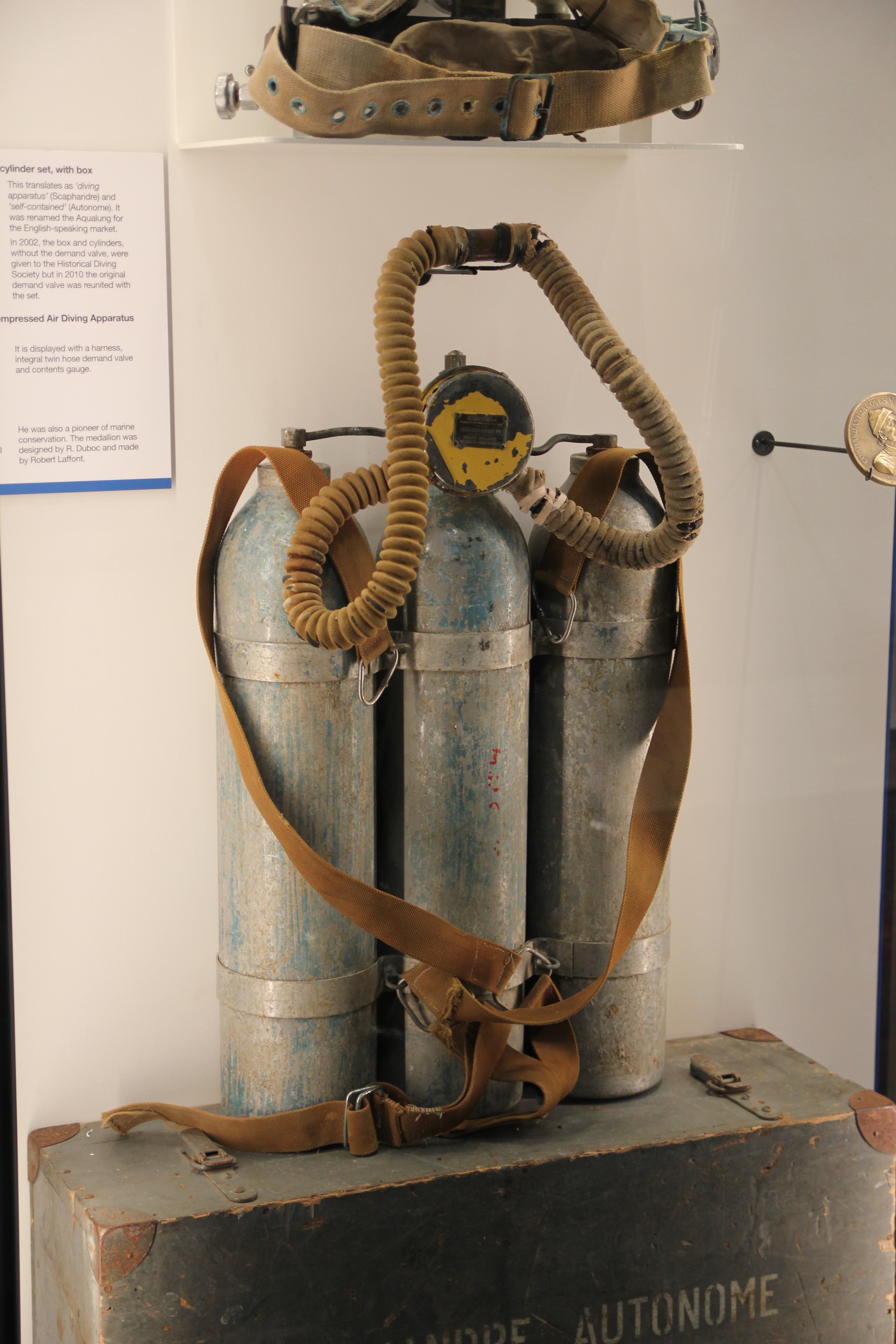

A demand regulator gives a diver air with each inhale, at a pressure matched to the surrounding water. In 1943 the French naval officer Jacques-Yves Cousteau and the Air Liquide engineer Émile Gagnan developed an autonomous diving system built around one: the Aqua-Lung.1,2,3
A valve from the 1860s
The core idea is older than scuba. PADI's history of the regulator credits Benoît Rouquayrol as the first to conceive and patent the demand valve, in 1860; one diving-history account gives the month as April. Working with the sailor Auguste Denayrouze, he went on to produce in 1864 what a regional heritage site calls the first modern self-contained diving suit, built around a membrane regulator.4,5,6
According to one diving-history account, the diver carried a reserve of compressed air on his back, and the surrounding water pressure acting on a flexible membrane opened a valve to let the air flow. PADI says the pair's regulator was used with surface-supplied air; the same diving-history account gives the high-pressure, autonomous version an endurance of about 25 minutes at 10 metres. According to the regional heritage site, Jules Verne drew on these devices to equip Captain Nemo in Twenty Thousand Leagues Under the Sea.4,5,6
Le Prieur and the problem of constant flow
In the 1920s Captain Yves Le Prieur freed divers from the surface hose. The Cousteau Society dates his open-circuit, compressed-air device to 1925, and National Geographic also dates his autonomous breathing device to 1925. One history says he proposed using a compressed-air cylinder of the kind Michelin supplied in puncture-repair kits, and that he later filed a joint patent with Fernez for the Fernez-Le Prieur equipment.7,8,9
The weakness was the flow itself. The air flowed continuously, so the supply ran out quickly and time underwater was limited. Others kept working on the problem through the war: according to one collectors' history, Georges Commeinhes made a dive to 53 metres off Marseille on 30 July 1943.7,8,9
A gas valve for wartime cars
Émile Gagnan was an Air Liquide engineer specialising in high-pressure pneumatics. In wartime France fuel was scarce: the Cousteau Society notes that the Germans requisitioned automobile fuel, and History.com that gasoline and diesel were in short supply. Gagnan had designed a demand regulator to feed an alternative fuel to car engines, though sources describe it differently: cooking gas to a carburettor, natural-gas conversion kits, or even cooking oil. One collectors' history says he adapted the Rouquayrol–Denayrouze regulator for the purpose, and the Lemelson Center notes that a similar valve had been used in gas-generator engines.2,7,8,9,10,11
The link to diving ran through the family. Simone Cousteau's father was an executive at Air Liquide (one collectors' history names him as Henri Melchior, a director of the company), and National Geographic says it was this father-in-law who put Cousteau in touch with Gagnan. Air Liquide's own account instead describes an encounter between Cousteau, Gagnan and Jean Delorme, whom it calls the company's chairman and CEO, and says Cousteau and Delorme asked Gagnan to design equipment for deep-sea exploration. National Geographic says Cousteau travelled to Paris in 1942 to explain the problem to Gagnan; one history gives the month of their meeting as December. Gagnan, by History.com's account, had never thought about diving equipment before.2,8,9,12
Summer 1943: from the Marne to the Mediterranean
The first trial was in a river near Paris. According to one detailed history, Cousteau tested a prototype with a single corrugated hose in the Marne on 22 June 1943 and found that breathing was hard head-down while air rushed in head-up; another account says simply that the river test did not work. According to the same history, Cousteau then suggested adding a second hose so that exhaled air returned against the membrane.9,13
Accounts of the first sea dive vary. The Cousteau Society places it in June 1943 on a small Riviera beach, and History.com in June 1943 in the Mediterranean; the same detailed history gives 4 July, at Barry beach in Bandol, with Frédéric Dumas and Simone Cousteau. National Geographic describes Cousteau, the naval officer Philippe Tailliez and Dumas testing the device cautiously over many months in 1943, making more than 500 dives in the Mediterranean and going a little deeper each time. The Cousteau Society adds that the new equipment reduced fatigue and so cut air consumption.2,7,8,9,14
Patent, La Spirotechnique and America
Aqualung's company timeline says the patent application was filed in 1943; one history says it was filed as the Scaphandre Cousteau-Gagnan and that Cousteau insisted that Gagnan's name be on it. The same timeline says the patent was awarded in 1948. The United States patent, No. 2,485,039, titled Diving unit, was filed in March 1947, cites a French application of 8 July 1943 and was granted in October 1949. Its stated aim was to feed the diver only the gas needed for normal breathing.1,3,9,15
The regulator went into production as the CG-45. The History of Diving Museum says the name joins the inventors' initials and the production year, 1945; the International Scuba Diving Hall of Fame says the 45 is the patent year. In 1946 Air Liquide set up La Spirotechnique to sell it, with sales starting on 26 May 1946 according to one history.3,9,10,11,16
The Hall of Fame says the first CG-45s reached the United States in 1948, imported by René Bussoz for his store in Westwood Village, Los Angeles, and that Bussoz formed U.S. Divers in 1950. Divers at Scripps Institution of Oceanography bought some, and their programme became the foundation of American scuba instruction. Other dates circulate: the Lemelson Center says US distribution rights were acquired in 1952, and Air Liquide's purchase of U.S. Divers is dated 1956 by Aqualung and 1958 by the Lemelson Center. Gagnan emigrated to Montreal in 1947 and worked for Canada Liquid Air; sources disagree on when he died, 1979 or 1984.1,3,10,11,16
What remains today
Le Prieur's apparatus limited dive time because its air flowed continuously. The Cousteau–Gagnan valve supplied compressed air on demand and adjusted to the surrounding pressure, and the Cousteau Society says the new equipment reduced fatigue and air consumption. National Geographic says that within roughly a decade the Aqua-Lung had been adopted by the public as a recreational pursuit, and that more than 28 million people have since learned to dive.1,7,8
La Spirotechnique is the former name of Aqua Lung. Air Liquide sold Aqua Lung to Montagu Private Equity in December 2016; the company became Aqualung Group in 2021, was acquired by Barings in December 2023, and, after entering receivership, was taken over by HEAD, which said in 2025 it would maintain the Aqualung brand.3,12,17,18
The principle is the lasting legacy. The Lemelson Center calls the Aqua-Lung system part of virtually every set of modern scuba gear, and PADI describes the demand valve as the starting point for today's regulator. In Espalion, according to a regional heritage site, the Musée du Scaphandre, founded in 1977, honours Rouquayrol and Denayrouze.5,6,11
Sources
- 1. invent.org
- 2. history.com
- 3. us.aqualung.com
- 4. blutimescubahistory.com
- 5. blog.padi.com
- 6. grandsudinsolite.fr
- 7. cousteau.org
- 8. nationalgeographic.com
- 9. spiro-vintage.com
- 10. divingmuseum.org
- 11. lemelson.mit.edu
- 12. airliquide.com
- 13. ebsco.com
- 14. britannica.com
- 15. patents.google.com
- 16. isdhf.visitcaymanislands.com
- 17. airliquide.com
- 18. divemagazine.com
Sources checked on 19 November 2026. Written from these pages and checked by an independent second reader.
Where to dive next month
One email a month, around the 25th: the destinations in season the following month, with their sources, an article to read and an instructor's tip. Free, no ads.