
Silfra: diving in the crack between two plates

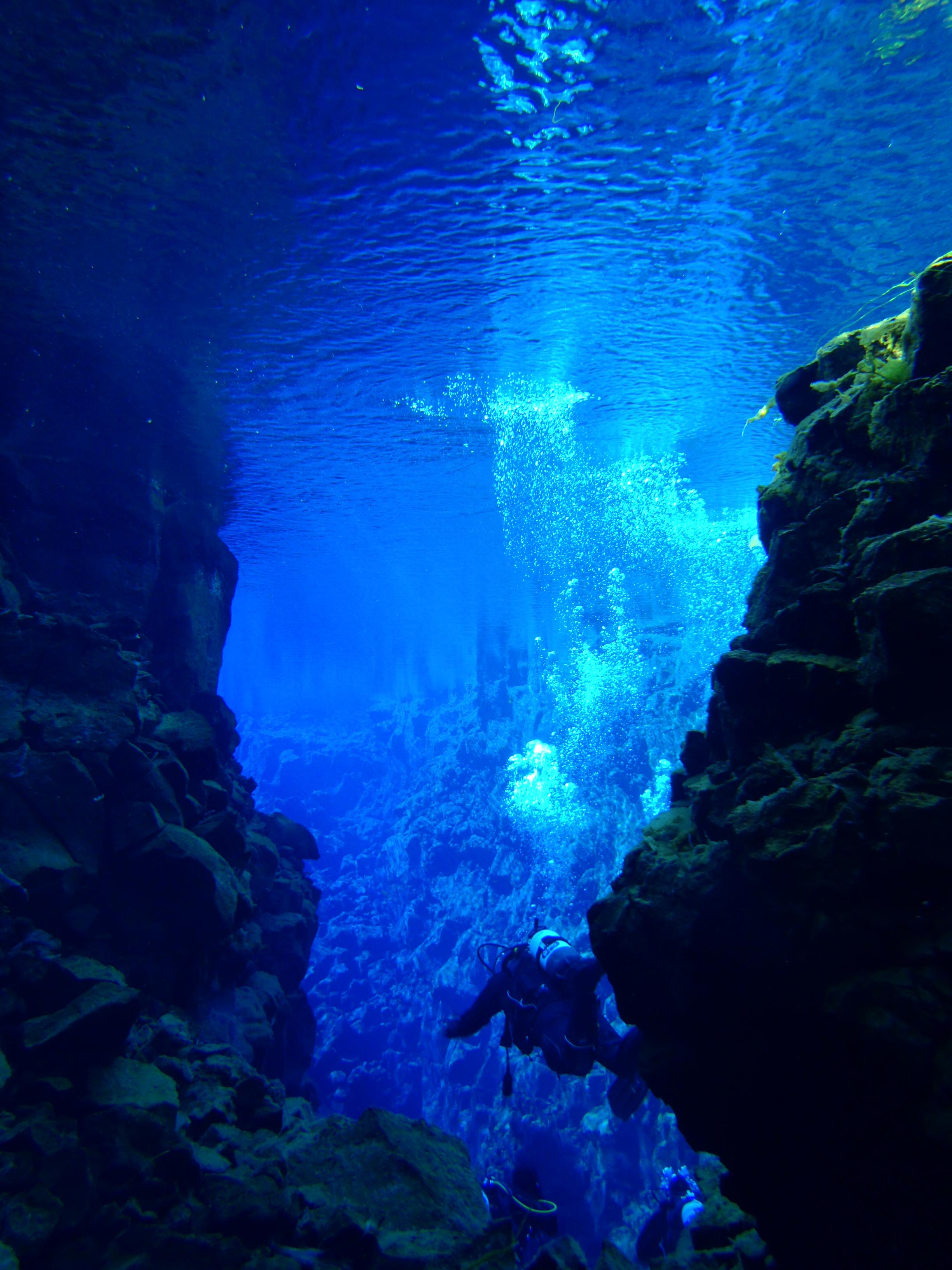

In Þingvellir National Park lies a fissure called Silfra. The park describes it as one of the best spots for diving in Iceland, famous for the astounding visibility in its clear, cold mineral water.1
A rift you can swim in
Þingvellir sits on the plate boundaries of the Mid-Atlantic Ridge, and the park says its faults and fissures make the rifting of the crust visible. Popular and press accounts describe Silfra as a gap between the North American and Eurasian plates. The national park's own page puts it slightly differently: it says the rift valley holding Silfra separates the North American plate from the Hreppar microplate.2,3,4,5
Accounts agree that the plates move apart by about two centimetres a year. Smithsonian magazine reports that this builds tension that is released in a major earthquake every ten years, and PADI states that the rift itself was formed in 1789 by earthquakes accompanying the plates' divergence.3,4,6
The movement shows in the landscape. UNESCO notes that the floor of the valley has subsided by some 3–4 metres since the Alþing was founded at Þingvellir. Cosmos magazine gives the fissure's greatest depth as 63 metres, and an AFP report describes the rift as more than 60 metres deep. Divers, however, may only use the top part: the park sets an 18-metre limit.1,4,7,8
Glacier water, filtered by lava
The water comes from Langjökull, Iceland's second-largest glacier, which Cosmos places about 50 kilometres to the north. Meltwater travels underground through porous lava before emerging at springs; the park calls Silfra one of the most prominent springs in the area.3,4,5
How long that journey takes depends on the source. PADI gives 30 to 100 years, Smithsonian quotes a guide saying 70 to 100 years, Cosmos says up to 100 years to reach the lake, and AFP says several decades through underground aquifers around 50 kilometres long.3,4,6,8
Visibility, temperature and the three sections
PADI and AFP both report that underwater visibility can exceed 100 metres. The park gives the water temperature as 2–4 °C, the same range PADI states; AFP reports two to three degrees all year.1,3,8
Cosmos describes three sections: Silfra Hall, Silfra Cathedral and Silfra Lagoon. It calls the Cathedral a 100-metre-long fissure with visibility almost from end to end. Smithsonian describes long, bright green growth in the lagoon section.4,6
A parliament on the rift
Þingvellir is also where Iceland's assembly, the Althing, met each year from 930 to 1798, according to Britannica; UNESCO adds that it gathered over two weeks a year to set laws. UNESCO says the park's best-defined feature is a major rift whose fissures and cliffs demonstrate inter-continental drifting, and Britannica notes it was designated a World Heritage Site in 2004.7,9
Accidents and stricter rules
Silfra was briefly closed in 2017 after a tourist in his sixties died there, the second death in the fissure that year, Iceland Monitor reported. It reopened with stricter rules, including fewer people per guide, required dry-suit experience and a health check before a dive or snorkel.10
Iceland Monitor's August 2018 follow-up listed further conditions introduced in March 2017, among them controlled access to the site and the ability to swim, and reported that even stricter rules had been implemented the previous month. The park's director said then that no serious accidents or incidents had occurred since the safety measures were increased, while, citing Morgunblaðið, the paper reported scuba-diving numbers down by 60–70 per cent.11
Before you go: the park's rules
The rules below come from the national park's own diving pages. They cover Silfra and a second permitted rift, Davíðsgjá, which lies in Lake Þingvallavatn itself and is reached by swimming out from the shore. The park notes that diving and snorkelling are entirely at the visitor's own risk.1,12
- All dives and snorkels in Silfra must be registered, and permission is given on condition of meeting the rules and paying for the dive.12
- Individuals who register must accept a liability statement and pay a visitor fee; the park pages do not state the amount.12
- Divers need a licence equivalent to Autonomous Diver and a dry-suit certificate, or proof of 10 registered dry-suit dives in the last two years.1
- Diving in a wetsuit is not allowed; snorkellers may use a well-fitting thick wetsuit.1,12
- Bring full cold-water protection, including hood, gloves and neoprene shoes or socks; the park does not provide equipment.1,12
- Never enter alone: always dive or snorkel with a buddy.1
- Maximum depth is 18 metres, and caves and other overhead environments are off limits.1
- Operators require a medical screening form; independent visitors confirm their fitness when booking the permit.1
Sources
- 1. thingvellir.is
- 2. thingvellir.is
- 3. padi.com
- 4. cosmosmagazine.com
- 5. thingvellir.is
- 6. smithsonianmag.com
- 7. whc.unesco.org
- 8. malaymail.com
- 9. britannica.com
- 10. icelandmonitor.mbl.is
- 11. icelandmonitor.mbl.is
- 12. thingvellir.is
Sources checked on 19 November 2026. Written from these pages and checked by an independent second reader.
Where to dive next month
One email a month, around the 25th: the destinations in season the following month, with their sources, an article to read and an instructor's tip. Free, no ads.