
The sponge diver who freedived to 70–88 metres in 1913

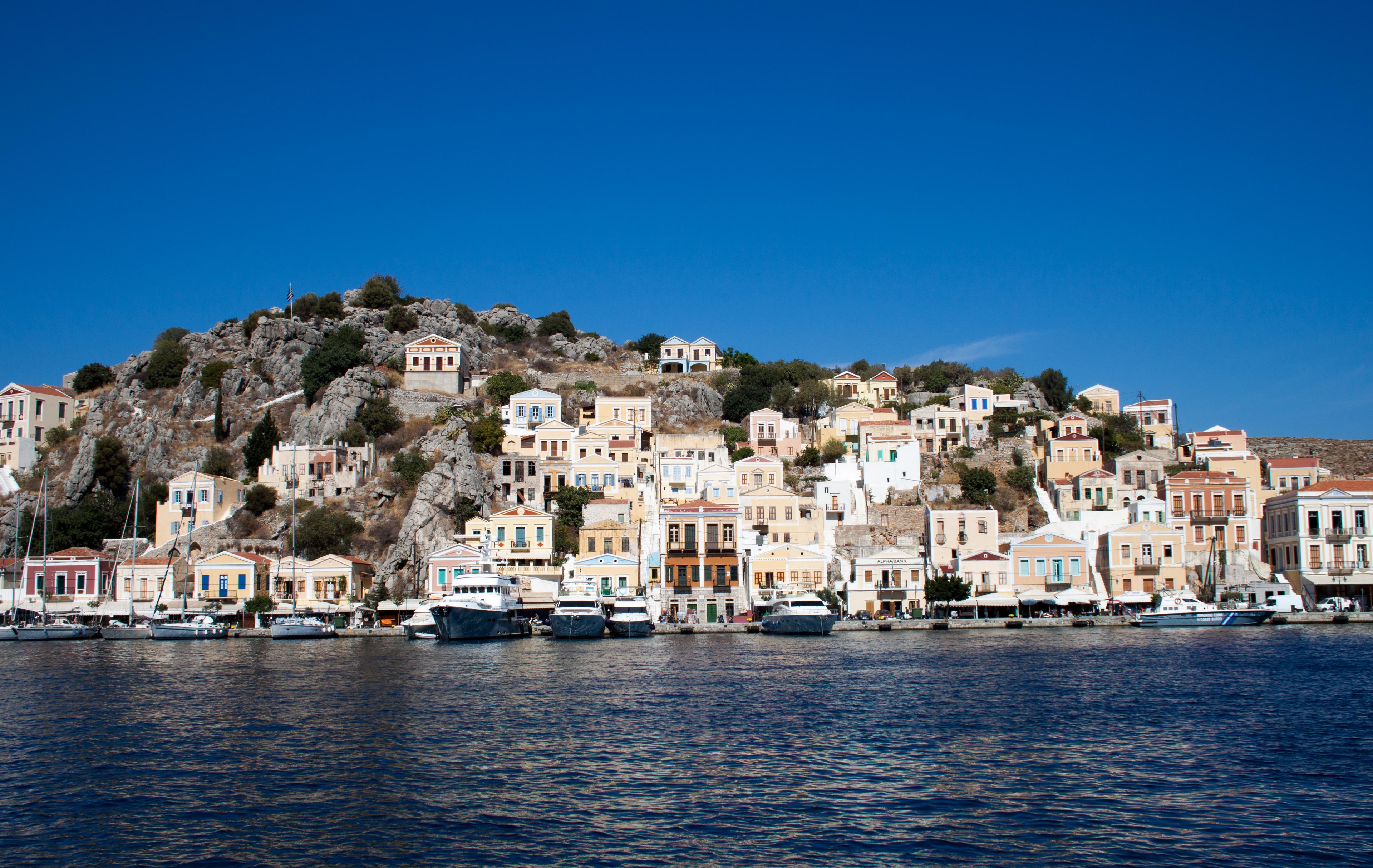

In 1913 an Italian warship lost its anchor off Karpathos, and the man who went down for it was aided only by a flat stone. Stathis Hatzis, a sponge diver from Symi, is at the centre of what a French medical society article calls the first description of a deep breath-hold dive, although the depth, the time and even the date change from one telling to the next.1,2,3,4
A diver from the sponge islands
Hatzis came from the island of Symi, and his name appears in several forms: Stathis Hatzis in Greek sources, Georgis Stathis Hatzis in a DAN article, and Haggi Statti or Giorgios Statti in Italian, French and scientific accounts. One Greek article gives his birth year as 1878.1,2,5,6,7
DAN describes the Dodecanese Islands as places whose economy depended on diving for centuries, part of a continuous tradition of occupational breath-hold diving. On Symi itself, legends remember the Sarandaki brothers as 'gymnasts' able to reach 40 fathoms, about 240 feet.1
The tool of that trade was the skandalopetra: a flat, smooth stone of marble or granite weighing between 8 and 14 kg, tied to the diver by a thin cord that also ran up to the boat. The diver rode the stone down, steering it by tilting it, and a companion in the boat hauled him back up by the rope. A marine biology review describes Hatzis using a flat stone of about 15 kg.3,5,8
An anchor lost off Karpathos
The ship was the Regina Margherita, an Italian battleship. According to a peer-reviewed review of diving in marine biology, its anchor was lost at a depth of over 70 m in Pigadia Bay, Karpathos. One Greek account says a chain link broke as the ship was leaving and the anchor fell back into the sea.3,7
Sources do not agree on when this happened. Italian and diving-press accounts give 14 July 1913; a Greek news report on a 2016 competition gives 16 July 1913; another Greek article says August 1913; and one travel article dates the episode to 1912.5,7,9,10,11
The dives
Hatzis did not reach the anchor in one attempt. An Italian account says he got there after 21 dives over four days, a French medical society article says the anchor came up after four days of repeated breath-holds, one Greek report credits his fifth dive, and another Greek article speaks of three days of dive after dive.4,9,12,13
The depth varies widely. Scientific papers cite 70 m; DAN gives about 250 feet; the French article says the anchor was raised from 76 m from a bottom of around 80 m; a Greek report says 77 m; Italian and diving-press accounts give 83 m; and Greek community and freediving sources give 87.5 or 88 m. One article adds that some of his search dives reached 100 m.1,2,4,5,6,7,8,9,13,14,15
The times differ too: three and a half minutes for the final dive according to DAN, 3 minutes 58 seconds on the bottom according to Greek accounts, and four minutes and six seconds in a travel article that says the ship's Italian doctors thought he had drowned.1,8,9,11
Several accounts say he came up close to collapse. Greek sources describe blood from his nose, or from his nose and ears, and say he was nearly unconscious.2,7,13
What the doctors saw
The most striking part of the story is the man himself. A 2012 paper on the lung volumes of extreme breath-hold divers notes that the ship's doctor described the Greek diver as emphysematous. DAN writes that he could hold his breath at the surface for no more than 40 seconds.1,14
An Italian account of the medical examination reports pulmonary emphysema, 20 to 22 breaths and 80 to 90 heartbeats a minute, a dry breath-hold of 40 seconds, and breath-holds in water between 1:30 and 3:30. It also says the ship's doctor went as far as suggesting that skin might absorb oxygen under pressure.12
A French article on breath-hold records says the episode is attested in Italian navy writings, and that the freediver Jacques Mayol later found the period documents. It reports Mayol's reading: the deafness came from perforated eardrums, and the 'fullness' Hatzis described in his chest was the first description of the blood shift. One freediving history adds that Italian naval records confirmed the feat in 2001.4,15
Rewards and a short life
Even the reward has several versions: a gold medal and free passage for life on Italian ships, £5 and lifetime permission to fish with dynamite, or simply paint for his boat. Greek sources say he later developed cancer and died at 58, while another gives 53.2,7,9,13,15
Why freedivers still tell his story
Physiologists still cite him. A 2021 review in Frontiers in Physiology mentions, near the start of its introduction, what it calls the famous anecdote of Giorgios Statti diving to 70 m in 1913, and a 2012 paper on the lung volumes of extreme breath-hold divers also discusses his case.6,14
The technique he used has also come back as a sport. According to the Symi magazine Sympossio, skandalopetra competitions now fall under the world underwater federation, CMAS, and divers may not wear wetsuits, masks or fins. In July 2016 a competition at Karpathos was held at the spot of his dive, where Chronis Chlitsios reached 80.7 m to break the Greek record.5,8,9
Sources
- 1. dan.org
- 2. usa.greekreporter.com
- 3. riviste.unige.it
- 4. cdn2.splf.fr
- 5. scubaportal.it
- 6. frontiersin.org
- 7. alchemy.gr
- 8. sympossio.gr
- 9. cnn.gr
- 10. deeperblue.com
- 11. greecewithin.com
- 12. scubaportal.it
- 13. cosmosphilly.com
- 14. doc.rero.ch
- 15. deeperblue.com
Sources checked on 19 November 2026. Written from these pages and checked by an independent second reader.
Where to dive next month
One email a month, around the 25th: the destinations in season the following month, with their sources, an article to read and an instructor's tip. Free, no ads.